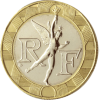
I was surprised to find a French Indo-China coin listed as being composed of "nickel silver", so I checked KM and found that the composition was in fact nickel brass. I've requested the correction but this prompted me to search for "nickel silver", a search which resulted in 728 hits. I suspect that none of these coins contains any silver at all. The term "nickel silver" has long been banned here in the UK because of its fraudulent use, implying that a base metal object contains a precious metal. Can I suggest that we work to remove all references to this misleading term from our catalogue?
Former Numista referee for banknotes from Ireland, Northern Ireland, Scotland, Wales and Saint Helena.
"Nordic gold" and "German silver" come under the same category as for me. They're both misleading. Thankfully, "German silver" only gives 40 hits in Numista, none of which are in the composition field. Unfortunately, "Nordic gold" has been used for the euro coins among others (1437 hits in total) and so will be a pain to remove. That doesn't make it right to leave it in, however.
Former Numista referee for banknotes from Ireland, Northern Ireland, Scotland, Wales and Saint Helena.
It was agreed to have 2 entries for alloys of copper, nickel and zinc:
- Maillechort (fr) / Nickel silver (en) when the alloy is white
- Laiton de nickel (fr) / Nickel brass (en) when the alloy is yellow.
This type of alloys seems to have many names: "Nickel silver, Maillechort, German silver,[1] Argentan,[1] new silver,[1] nickel brass,[2] albata,[3] alpacca" (https://en.wikipedia.org/wiki/Nickel_silver).
The name "nickel silver" looks quite common, although it's true that the alloy contains no silver.
I'm happy to listen to the opinions of more people, so we can find the best solution.
I've now across another example where the use of "nickel silver" is causing confusion. The Belgian 5, 10 and 25 centimes coins struck in the 1930s used a white coloured alloy of copper, nickel and zinc. Some are currently listed as "nickel brass", others as "nickel silver" with two even given as "copper-nickel". To add to the confusion, various different proportions are given, some of which are clearly erroneous. Two which could be correct are 64% Cu, 20% Zn, 16% Ni and 75% Cu, 10% Zn, 15% Ni. Of these, the first agrees with the Wikipedia article https://fr.wikipedia.org/wiki/Pi%C3%A8ces_de_monnaie_en_franc_belge
Assuming that all these were struck in the same alloy, we need to determine it's elemental composition and then decide what to call it.
Former Numista referee for banknotes from Ireland, Northern Ireland, Scotland, Wales and Saint Helena.
Verweis : "ceh2019"I've now across another example where the use of "nickel silver" is causing confusion. The Belgian 5, 10 and 25 centimes coins struck in the 1930s used a white coloured alloy of copper, nickel and zinc. Some are currently listed as "nickel brass", others as "nickel silver" with two even given as "copper-nickel". To add to the confusion, various different proportions are given, some of which are clearly erroneous. Two which could be correct are 64% Cu, 20% Zn, 16% Ni and 75% Cu, 10% Zn, 15% Ni. Of these, the first agrees with the Wikipedia article
https://fr.wikipedia.org/wiki/Pi%C3%A8ces_de_monnaie_en_franc_belge
Assuming that all these were struck in the same alloy, we need to determine it's elemental composition and then decide what to call it.
According to my catalog only the ones under Leopold III (1938-40) are Cu 64%, Zn 20%, Ni 16%.
The ones under Albert I are Cu 75%, Ni 25% with the exception of the 5 and 10 Centimes that have a star above the value (1930-32), these are Cu 75%, Ni 15%, Zn 10%.
I wish I had a copy of one! Can you tell us if they name these alloys or just given the elemental compositions? I'm keen to get away from the term "nickel silver" and I know in French the term used is maillechort. This does exist in English (it's in the OED) but it isn't very common. Aparantly, it's named after the two inventors of the alloy.
Former Numista referee for banknotes from Ireland, Northern Ireland, Scotland, Wales and Saint Helena.
I used saw that one of the catalogs uses the term 'maillechort' in the description of those Centimes. But they use the term for any composition that had copper, nickel and zinc, regardless of the percentages.
In both coins Nickel is the main metal. Copper and zinc are then added in various percentages and Cu-Zn together is Brass. So Nickel-Brass sounds correct.
For myself however, I like to note the compositions as detailed as possible and I try to avoid generic terms as brass, bronze, Nordic gold, etc.... This proves to be very difficult because even the Central Banks or Mints or whoever makes the coins, are at most times not very clear in the compositions they use...
Verweis : "Newtony"Official catalog for Belgian Coins, by Peter Eyckmans en Frans Morin.
Or Numismatica Belgica by Joselito Eeckhout.
Both are excellent!
There is a third excellen Belgian catalogue, with much more pictures of varieties:
Catalogus van Belgische Numismatische Uitgiften by Laurens Aernout. By the way, he's a member of Numista (Aernout86) and a specialist in Belgian varieties. This is his website where you can see a picture of his catalogue: http://www.cbnu.be/home/
Official catalog for Belgian Coins, by Peter Eyckmans en Frans Morin.
Catalogus van Belgische Numismatische Uitgiften by Laurens Aernout.
Both these catalogues cost around 15 € and they both deliver worldwide. The shipment costs for the second one is 14 € within Europe, 22 € worldwide. I don't know the shipment costs for the first one but I can call Peter and ask him if you want.
Official catalog for Belgian Coins, by Peter Eyckmans en Frans Morin.
Catalogus van Belgische Numismatische Uitgiften by Laurens Aernout.
Both these catalogues cost around 15 € and they both deliver worldwide. The shipment costs for the second one is 14 € within Europe, 22 € worldwide. I don't know the shipment costs for the first one but I can call Peter and ask him if you want.
How could I forget the catalog by Laurens Aernout! Also a very good reference!
I also forgot to mention that the Numismatica Belgica seems to have stopped around 2010...
So for recent up-to-date catalogs only the other two remain!
Verweis : "ceh2019""Nordic gold" and "German silver" come under the same category as for me. They're both misleading.
Or, this is a radical thought, I know, maybe umismatics should just learn what Nordic Gold and German Silver means? Why should be remove the correct terms, just because there are some who don't know what it means? Isn't it better to just inform them what it means, instead of removing the term? I reckon it's better to rename the catalogues * Tokens * and ** Exonumia **, since no one, still, seems to know the difference between these two.
Radical is one word for it. One problem with that notion is that silver and gold already have meanings and I don't think the entire discipline of chemistry is going to shift just because a few coin collectors want them to. Another problem is that the terms "nickel silver" and "nordic gold" have been devised to deceive. The inventors of "nordic gold" are getting away with it for now because it's only used to make coins but you can't legally advertise for sale something as being composed of "nickel silver" (or "German silver") since they contain no silver. The real worry is that in the Wild West otherwise called the internet, people are selling perfectly legitimate coins at inflated prices by implying that "nickel silver" means it contains silver.
The work-around of making sure the actual elemental composition is shown is a good start but we need to eliminate these misleading terms. The problem isn't ignorance, it's inaccuracy.
Former Numista referee for banknotes from Ireland, Northern Ireland, Scotland, Wales and Saint Helena.
Verweis : "ceh2019"The inventors of "nordic gold" are getting away with it for now because it's only used to make coins but you can't legally advertise for sale something as being composed of "nickel silver" (or "German silver") since they contain no silver.
I'm not sure what you mean with this. We've had coins made of Nordic gold in circulation here since 1991, and no one has ever believed they were actually made of gold. So it's all about knowledge.
With this logic words like "Noisome" shoukd be chabge too, since it has nothing with noise to do. Or "quicksand" should be changed too, since it has nothing to do with being quick/fast. There are a lot of words that seems to mean something they don't. So why stop with the Nordic gold and German silver?
I'm afraid your counter-examples are poorly chosen as quicksand means "sand which is alive" (quick meaning alive rather than fast, as in the quick of a nail) whilst noisome comes from the archaic word "noy" (as in "annoyance") rather than noise.
Both terms under discussion are relatively recent inventions which were chosen to confuse. Just because those Swedes who know their 10 kronor coins are made of an alloy called "Nordic gold" also know that it doesn't contain gold doesn't take away from the fact that it is fundamentally misleading to the rest of the world's population. Add to this the fact that it's illegal to advertise something as being made from either "German silver" or "nickel silver" and we should be doing everything we can to eliminate these terms from our catalogue.
Note that the French version of Numista uses Maillechort as the corresponding term to "nickel silver". We should be considering what term to use on the English version.
Former Numista referee for banknotes from Ireland, Northern Ireland, Scotland, Wales and Saint Helena.
Wikipedia uses “Nickel Silver” rather than “Maillechort” (which it uses for French translation of article) and redirects “Nickel Brass” to the same. I'd support following their example. https://en.wikipedia.org/wiki/Nickel_silver
We keep going around and around on this. I still maintain if the mint that made the coins says it's “nickel silver” then that's what the composition should be listed as along with the actual composition when known.
We keep going around and around on this. I still maintain if the mint that made the coins says it's “nickel silver” then that's what the composition should be listed as along with the actual composition when known.
We have to avoid misleading people. If we know there's no silver in a coin then we can't use “nickel silver” without giving the true composition. If the exact composition isn't known, leaving just “nickel silver” isn't acceptable.
Former Numista referee for banknotes from Ireland, Northern Ireland, Scotland, Wales and Saint Helena.
In the first half of the 19th century silver and copper were often used to make household items.
Then manufacturers in Germany started using alloys that were similar in color as silver but were made from copper-nickel-tin in various proportions. They called it German silver or Argentan so they could sell it to people.
At the same time in France they were doing the same but they called it Maillechort or Melchior.
In more modern times we have Nordic Gold.
Alle of these names are a kind of ‘brand name’ so it could be sold easier… No doubt many people in the 19th century actually believed there was silver in these alloys.
If my company should get a contract from a big country to supply it with the necessary alloys for making coins, that company doesn't call it a 60% copper-30% nickel-7% tin-and so forth alloy!
No, they give it a catchy name like ‘Roman gold’ or whatever.
So just stop using those brand names and start using the correct contents of the metals used in that alloy.
It's easy to just add 60% copper, 20% nickel, 20% zinc in the Additional details field just below the Composition field. “Problem” solved.
Not solved. We'd be making up an alloy composition without knowing if it was true. Case in point: N#14260 contains only 12% nickel but is still called nickel silver by the mint. We'd just be guessing how the remainder 88% was split between copper and zinc.
It would be a complete disservice to change a misunderstood composition to wrong composition.
So just stop using those brand names and start using the correct contents of the metals used in that alloy.
ceh2019
We have to avoid misleading people. If we know there's no silver in a coin then we can't use “nickel silver” without giving the true composition.
I would completely agree but how do you propose to find the correct contents/true composition? The best you could do in most cases is assume “Copper plus nickel plus zinc alloy” as the composition.
It's easy to just add 60% copper, 20% nickel, 20% zinc in the Additional details field just below the Composition field. “Problem” solved.
Not solved. We'd be making up an alloy composition without knowing if it was true. Case in point: N#14260 contains only 12% nickel but is still called nickel silver by the mint. We'd just be guessing how the remainder 88% was split between copper and zinc.
It would be a complete disservice to change a misunderstood composition to wrong composition.
Perhaps the coin has been edited since you linked to it but it now says nickel brass. Do you have a link to the mint where the composition is called nickel silver? I agree that we musn't “make up” a composition. Instead, if we know the alloy's elemental content but not the exact proportions, we list the elements.
Former Numista referee for banknotes from Ireland, Northern Ireland, Scotland, Wales and Saint Helena.
Perhaps the coin has been edited since you linked to it but it now says nickel brass. Do you have a link to the mint where the composition is called nickel silver? I agree that we musn't “make up” a composition. Instead, if we know the alloy's elemental content but not the exact proportions, we list the elements.
I'm not sure when/if this was changed but it's the same coin we both discussed here: https://en.numista.com/forum/topic117302.html (US mint). SCWC says it's “Copper-Nickel-Zinc” for what it's worth.
I don't think we should get stuck on this particular coin though. There are over 1,200 coins/token in the catalogs with a “nickel silver" composition. There is no single composition that could be used for all of them. What I don't like about calling it nickel brass is that there are brass alloys containing nickel that still appear as yellowish brass rather than silvery. Keeping the term “nickel silver” helps to convey the appearance is that of silver, not brass. If a massive, across the board change, is going to be applied to these 1,200 plus items, I would propose, in the absence of the exact composition, that the change is to keep composition as nickel silver with the suggestion of ngdawa adding “copper, nickel, zinc” under Additional details (without exact values).
If a massive, across the board change, is going to be applied to these 1,200 plus items, I would propose, in the absence of the exact composition, that the change is to keep composition as nickel silver with the suggestion of ngdawa adding “copper, nickel, zinc” under Additional details (without exact values).
This will certainly do as an interim measure until we can eradicate the term all together. I'm sure most of the coins so labelled can have their exact compositions determined with a little work. Is this a job for the robot?
Former Numista referee for banknotes from Ireland, Northern Ireland, Scotland, Wales and Saint Helena.
This will certainly do as an interim measure until we can eradicate the term all together. I'm sure most of the coins so labelled can have their exact compositions determined with a little work. Is this a job for the robot?
You are much more optimistic than I. Yes, as a first step this should be done as it will help to solve questions like the OP's original question (in the other forum post) and not create any wrong information. At this point it's in the hands of the coin master referees, exonumia master referees and catalog administrators to make it happen.
“Nickel brass”, “nickel silver”, “alpaca”, “German silver”, etc. Too many confusing names for the same group of alloys. “Nickel brass” is as misleading as “nickel silver” because brass is normally yellow, so people start to search for a yellow coin while it is grey. Why don´t just remove all of these names from the list of alloys and change them for the elements of the periodic table: “copper-nickel-zinc”?
“Nickel brass”, “nickel silver”, “alpaca”, “German silver”, etc. Too many confusing names for the same group of alloys. “Nickel brass” is as misleading as “nickel silver” because brass is normally yellow, so people start to search for a yellow coin while it is grey. Why don´t just remove all of these names from the list of alloys and change them for the elements of the periodic table: “copper-nickel-zinc”?
Nickel brass is not as misleading as nickel silver since it does not lie about the composition. However, as a chemist, I'd be happy to replace all of these with copper-nickel-zinc, perhaps with the option of adding the colour of the alloy too. It ought to be possible, from those coins with known percentages, to build up a table of which compositions have which colour and use this as a basis for assigning all the various versions.
Former Numista referee for banknotes from Ireland, Northern Ireland, Scotland, Wales and Saint Helena.
Once again, I see that the opinions, in many cases, are based on their own knowledge and the experience of people who have been collecting for a long time and not on what a large majority of the 186 007 members in Numista may know or need.
I also believe that the expression nickel-silver can lead to confusion for many collectors not very accustomed to certain technical languages, so, since there are other options that are just as valid and that would not lead to confusion in any case, why not use them?
The expression nickel-brass can also lead to confusion, since many of us associate brass with a yellowish color, so, for me, the best option would be copper-nickel-zinc. Either of these two options would be appropriate in my opinion, since the alloy contains nickel, copper and zinc (nickel-brass), but including "silver" in the name could lead one to think that this metal is in the composition, and that I think we should avoid it.
Coin referee for: Andorra, Equatorial Guinea, Marshall Islands, Moldova, Liberia and Spain
Banknote referee for: Andorra, Equatorial Guinea and Spain
Status geändert zu Abgelehnt(Jarcek, 13 Jun. 2023, 11:16)
All that discussion went by me somehow but has recently popped up again.
I was just confused by the term Nickel-Brass as from numismatic books I now it as a metal being more yellowish in color and not silver in color.
I would agree in it better be called Copper-Nickel-Zinc
By the way in Germany we do not call it German Silver. We call it Neusilber, I guess same as in Sweden.
If you like coins, medals and tokens with ship motives follow my new instagram account with regular updates @numisnautiker
From time to time I sell some coins on Ebay make sure to follow me @apuking on Ebay.